

I’m jumbled up, maybe I’m losing my touch? If I open my eyes, all I can see is impenetrable fog. Not every day, just at the moment. Can you tell what it is yet? In the strange world of my waking dreams, “Sugar Baby Love” holds a special place. I say these things to Wesley Storey all the time. Sometimes he laughs and thinks I’m joking, but I’m really not. When I was at school, the choice of mainstream pop was extensive. I prefer the word “bubblegum” to “glam”. The latter is a one-stop phrase for any thing that wasn’t soul or heavy rock. “Bubblegum” suggests that it has a disposable quality – here today, gone tomorrow. The Rubettes were a product of the rock ‘n’ roll revival that bubbled away in the background all through the Seventies. All manner of acts paid lip service to the music and fashions of the 1950’s, from Roy Wood’s sublime
Wizzard, to Mud, the Bay City Rollers, Showaddywaddy and of course, The
Rubettes. They competed with genuine tunes from the Fifties, “rediscovered” for a younger audience and reissued to death. When RCA reissued Elvis’ “Heartbreak Hotel” in 1971, it was to celebrate its fifteenth birthday. It was that recent. To put that in some sort of contemporary context, the first Girls Aloud single was released nineteen years ago this Christmas.
In the early Seventies, rock ‘n’ roll was in its infancy – a revival seems way too soon from here. But the innocence had gone, replaced by serious rock music, soul music with a message and Jamaican flavours. One of the biggest successes at Woodstock was Sha-na-na, simply because they reminded the audience of how much fun and how uncomplicated pop music was not that long ago. They were treated like a novelty by those “fucking hippies” as they called them and ultimately stole the show. Similarly, the rock ‘n’ roll revival manifested itself as one big novelty record – homing in on the fun, dressing up element, creating
contemporary pastiches of what music sounded like less than twenty years ago.
“Sugar Baby Love” falls into that category. In reality it has nothing to do with rock ‘n’ roll as we know it. It wasn’t a furthering of the genre in another time, far from it. It was a 1970’s attempt to sideline the more serious issues of the day in favour of something altogether more frivolous. If the three day week, the IRA, power cuts, spiralling unemployment and prog rock were causing you great heartache, The Rubettes and their ilk could whisk you back in time to an age when these pesky things didn’t exist and life was a tad freer and a lot easier. It may have been a wondrous notion to have your fears and anxieties washed away by pop music from a simpler time, but underneath it all and beyond “Sugar baby love”, “See My Baby Jive” and “Hey Rock’n’Roll” was an underlying darkness that would not go away. And, rather than shining a light on Britain’s plucky, never say die attitude to adversity, they just showed the lengths that people would go to, to escape the infernal dread that enveloped them. Having said that, it is a beautiful piece of escapism that captures that moment in the summer of 1974 perfectly. In the excellent Ramones documentary “End Of The Century” it is used in the opening sequence to depict, as it says on the screen: “Queens, 1974”. It captures that netherworld that The Ramones were born into and is typical of the big selling pop singles of that year. In essence The Ramones were closer in spirit to The Rubettes than say, Aerosmith in so much as they were both pastiches of groups and an age that never existed – whereas Aerosmith were being hailed as the new Rolling Stones, but with more drugs. “Sugar Baby Love” should have been forgotten about years ago, yet it has this loveliness that lives on long after the feeling has gone. It’s falsetto, Spector on the cheap intro is one of the great announcements in pop and contains no real band members in the performance, it being the work of session musicians and falsetto vocalist Paul Da Vinci under the direction of Wayne Bickerton and Tony Waddington who wrote the million selling beast. The Rubettes – like many before them – became a real band, went on tour and released further Fifties flavoured fare and had a decent run of success for a manufactured band. “Sugar Baby Love” remains up there, something ace you hear on the radio now and again, or as you’re pushing your trolley round Asda. It is one of the last gasps of innocence before the industry, the music and indeed society, changed forever and became the somewhat more growly, dark nation of discontent that saw out the decade. Enjoy. x
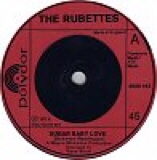
The Rubettes – Sugar Baby Love. Polydor 2058 442. March 1974.
 bernie@happening-things.com