
- Joy Division: Darkness and Light.
I saw Joy Division many times. They were the revelation of my eighteenth year. They stole everything I had and knew then re-arranged them in an order I may have been able to understand. I was very fortunate to collide with them in that very important part of my life, that difficult period between 17 and 18 when the receptors are looking out for new things to thrill and bend your mind and are working a double shift to find them.
I met the guitarist by the cigarette machine in Eric’s one night in early 1979 after they’d just played. I told him my name was Bernard too. He gave me his phone number and told me if I wanted to go and see them to give him a call, he’d put me on the guest list. Thus started a year of disappearing from Liverpool and turning up wherever they were playing, hitching and jumping trains to wherever I needed to be. It was a magical time of wonder and unshakeable possibilities.
An entire generation later, it’s really difficult to convey what Joy Division did to music during 1979. They had gone through a seismic shift in what they were all about, almost overnight. Gone was the punky thrash of the Stooges and the Pistols – in its place were soundscapes of otherworldly future-punk. A whole new
music, with a whole new set of rules. And, without even thinking in that way, they were beginning to alter not only how people were perceiving music but how music would be played and performed in the future.
Aah, the future. That’s where Joy Division lived, in this science fiction greyness which reflected the dark satanic mills status that Manchester was still locked into, nearing the end of the 20th century. They seemed inextricably linked, the
drab colourless nature of their surroundings informing the music they created and the
new environment they were inventing.
And here are the young men, indeed. That sound. In the post punk universe where anything was possible, Joy Division took a route that set them out on their own, with no competitors in a field of one. Those four young men created a sound that resonates in my head to this very moment – it’s difficult to even think for a moment how life would be without that awe inspiring wall of sculptured
noise.
I saw Joy Division many times – things spring up from place to place, I get confused as to which gig was which. One of the greatest spectacles in it all was the matinee performance at Eric’s in Liverpool in August of 1979. It was one of the greatest because they were utterly magnificent and more importantly there were children as young as 12, 13 years old in that audience getting a first hand account of the miracle (miraculous?) properties of music and giving them signposts as to what to do and where to go later.
Getting very towards the end they played at the original factory club, the PSV, Royce Road, Hulme. They organised a coach from Liverpool. The place was
packed. I have a vague memory that they began with The Sound Of Music and finished with Atrocity Exhibition (possibly the other way round). In between was one of the most ferocious sets I ever heard them play. Everything that was to be loved about this band was there, ramped up to the power of a billion. The power, the unbending light, the sheer force of where music can and will take you if youjust let go. Towards the end, even during the encore, Ian Curtis was a spent person – the energy of the performance completely draining him, the steam drifting in wisps from his red short sleeved shirt. It was a truly astonishing performance, the creation of a new and viable world, right before your very eyes. Five weeks later it was all over, forever. Joy Division were no more. Yet, for a year in my formative story they were – and still remain – an uplifting wondrous force that gave me an understanding of an incomplete universe that had to be cracked so I could move forward. The members of Joy Division themselves were at odds with all that, of course. They still wanted to be the Stooges.
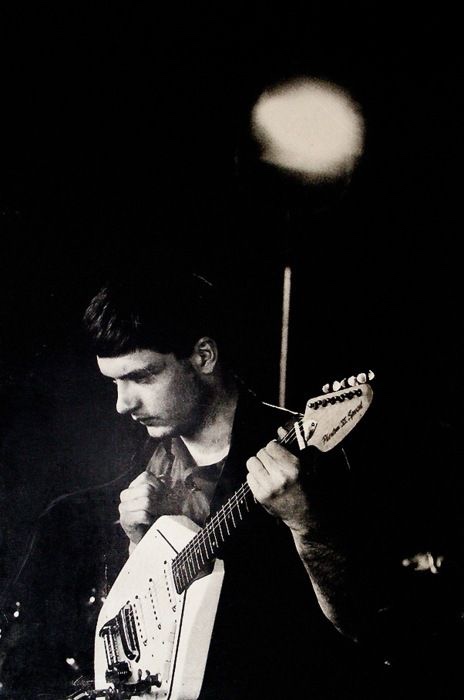
Ian Curtis 1956-1980.
 bernie@happening-things.com