

Somewhere, a long time ago, a music was forged that would become the basis of nearly all pop music in the second haldf of the last century. The Blues, as it became known, was folk music interpreted by African American musicians from music and songs that had been played in the fields as far back since before they were ‘free.’ The ownership of this music has been brought into contention in modern times, as the history and life of folk music became more apparent.
According to legend, Stack O’ Lee was a New Orleans pimp, a bad man, who would kill you as soon as look at you and was deemed above the law. As is the way with legend, it often appears more palatable than the truth and becomes more embellished each time the story is told. Its first recorded mention was in 1897, in the days before recorded sound, when folk tunes and songs were modified and changed to suit whichever parish or environment they found themselves in. In the early days of the last century, the folk music sung by both white and black performers were often the same songs with minor local variations in lyrics and parlance. Stack O’ Lee -or Stagger Lee- had an enduring life, he outlived the early folk blues singers to turn up in the reportoires of a range of diverse artists such as Duke Ellington, Pat Boone, Lloyd Price, Woody Guthrie, Nick Cave, The Isley Brothers, The Grateful Dead and The Clash.
A life way beyond any life expectation. And, of course here, at the hand of Mississippi John Hurt. Hurt’s rendition was recorded 97 years ago this year for Okeh Records in New York. At the time, Okeh’s A&R men owned the publishing arms of the business. They often encouraged their artists to plunder the songs from the rural fields and joints and claim authorship themselves, thus taking all the publishing royalties whilst never paying the artists a penny. The artists would receive a flat fee, summat like $50 a side, which in the 1920’s was big money for a sharecropper to earn for a few hours work.
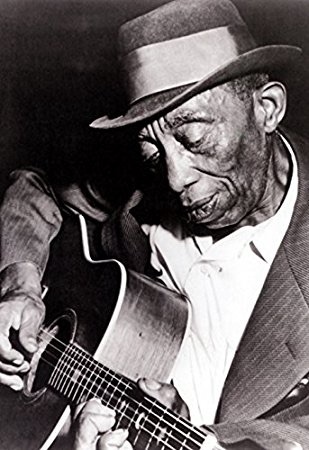
This is exactly what happened to John Hurt and countless others. Nearly every song he recorded for Okeh could be traced back to somewhere in the 19th century. And so it goes. John Hurt was a resident of Avalon, Mississippi, he was, like everyone in his town, a sharecropper.
In 1928 he recorded twelve sides for Okeh, the first of which was his rendition of the ‘Frankie and Johnny were lovers’ yarn, which he called simply ‘Frankie.’ His soft spoken, gentle Country Blues defined the songs he recorded and in a way created the definitive recordings of those songs. His follow up was ‘Stack O’ Lee Blues’ coupled with ‘Candy Man Blues’ another song that would take on a life of its own several decades later. His playing and his voice are simply mind blowing. The soft, warming nature of both sets his Blues apart from the other somewhat more harder, world weary material that was popular at the time.
On his records John Hurt sounds like he is serenading the heavens, his delivery serene and precise. I don’t know enough about music and chord structure and its theory to espouse here. Hearing is believing, and some years ago when my late, great friend Jake Brockman first played me this music it levelled me in exactly the same way Punk did. And House music did. Like a wake up call to something that was vitally important and would prove unmissable and life-affirming.
Not unusually, John Hurt was let down by the recording business, they promised him the earth and delivered nothing. After which he settled down into a life of total obscurity in Avalon, Mississippi.
Decades later, in 1952 and without his knowledge, two of his songs, Frankie and Spike Driver Blues, were included in hHarry Smith’s seminal Anthology of American Folk Music collection. This led to a resurgence in interest in not just John Hurt’s work, but all the artists included and the Country Blues idiom itself. These recordings became the obsession of music freaks -now known as musicologists- like Dick Spottswood.
Spottswood is attributed to ‘rediscovering’ Mississippi John Hurt. In 1963, when he set out to find him on person, the logical place to start he thought, based on the lyrics of the song -“Avalon, my home town, always on my mind”- would have been Avalon, Mississippi.
He and his friend Tom Hoskins drove there from New York City and asked the first person they saw if they knew Hurt, who directed them to his home. Yes, he still lived there decades later. When they knocked on his door in the dead of night, with their headlights shining into the shack, Hurt said he thought they were a lynch-mob, the kkk , and his number was up. They were astonished with ease in which their elusive hero had been found. To prove his authenticity, they had him peform Avalon Blues on his stoop on Hoskins’ guitar. Hurt himself owned no instrument, he had not played a guitar, let alone owned one for many, many years. Indeed his grandchildren claimed that they had no idea that he had ever been a musician let alone one of the seminal artists of the 20th century.
This meeting led to John Hurt leaving mississippi for the first time since the thirties. Spottswood signed him to Vanguard Records and found him a spot on the 1964 Newport Folk Festival, where alongside other recently ‘rediscovered’ musicians like Son House, Skip James and Bukka White, he wowed the young crowd with his dazzling beauty that hadn’t diminished one iota in his years of obscurity.
He subsequently recorded many sessions for Vanguard, including his magnificent 1966 offering Today, in which reinterpreted some of the ancient material he had recorded for Okeh in 1928. Achieving a new young following, becoming the kind of star he should have been in the twenties, adored by thousands and recognised as the pioneer he truly was.
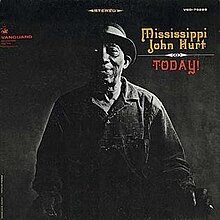
His moment in the the bright sunshine of success however. was all too brief. John Hurt died of a heart attack at the height of his new found celebrity in 1966, aged 74. Even that brief moment in the spotlight was no less than he deserved. He was one of the most influential musicians of the 20th century and his work should be held up as a shining example of an art that set the world alight and changed the music of several generations. His astonishing whisper and dazzling guitar technique is here forever, now. His music loved by millions all over the world.
These ground breaking soldiers of misfortune are the saints and angels of tomorrow’s world. Children of every age and from everywhere should be exposed to this awesome beauty as soon as they are old enough to reason.
Mississippi John Hurt makes the world a better place.
thanks, man.
Mississippi John Hurt
1892-1966
💙
 bernie@happening-things.com