
THE SOUND OF MUSIC HAPPENING THING:
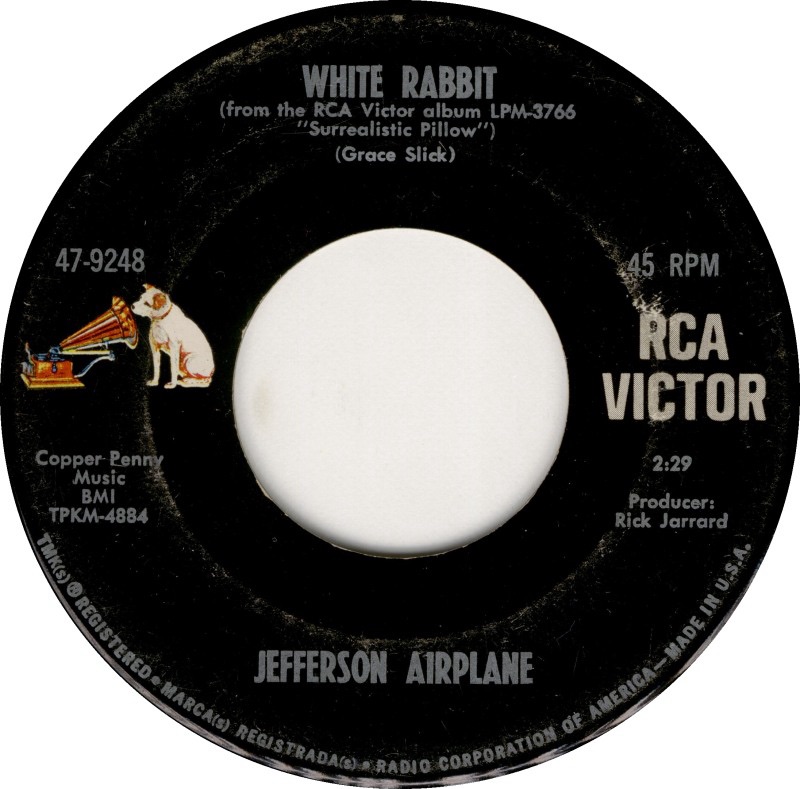
Jefferson Airplane – White Rabbit. RCA Victor 47-9248. June 1967.
Curiouser And Curiouser….
Across the canon of pop few ‘rock’ records stood out, made a difference as Jefferson Airplane’s surreal, druggy paean to another world, White Rabbit. In a moment in pop music’s relatively young history the Airplane abandoned the rules that had bound the industry for the previous decade and a half and took their colour drenched version into a new world where seemingly anything was possible. Like The Beatles’ Strawberry Fields Forever, recorded around the same months at the end of 1966 but released a few months previous, White Rabbit signalled a radical change in pop’s possibilities. A move that shifted away from the traditional boy meets girl template into a more sophisticated as yet undiscovered planet of more esoteric subject matter. Both records sold millions of copies and took their respected messages into the ears and hearts of a counter culture that for all intents and purposes was waiting for them to arrive.
Like Liverpool, San Francisco had always been seen as set apart from the rest of the nation and whatever it may have been doing. It had a long established counter cultural movement, steeped in the beat movement and underground culture. By the early sixties it had a thriving folk music scene that was catching fire across the country and would certainly have gone overground had it not been for those pesky Beatles turning up and spoiling it for everyone. By the middle of the decade the folk scene had collided with the world of novelist and Merry Prankster Ken Kesey and his wayward LSD parties known as the Acid Tests. Kesey had volunteered as a more than willing guinea pig to take the drug during psychology experiments at Stanford University and the results would change the face of the sixties, its culture, musicians, fashion, art, the whole nine yards, so to speak.
The collision between Kesey, Folk and LSD would be San Francisco’s doing and undoing, both in large doses. The netherworld which it created shuffled around briefly before the ideas exploded, first in a mass profusion of bands with unusual names. Then, as the media stranglehold happened as the epicentre of the hippie universe. A city of flashing lights and supposedly beautiful people.
White Rabbit was born into this world in the autumn of 1965. At the time Grace Slick, its creator had formed a band with her then husband called The Great Society. For the most aprt they were passed by during their existence but have since been recognised as one of the vital links between the folk movement and the explosion of colour that defined the city and the decade. During their brief moment in time they only recorded one single for Autumn Records, the label founded by legendary SF radio DJ Tom Donohue. The record, Free Advice coupled with an early version of White Rabbit’s sister smash Somebody To Love, at that point in time titled ‘Someone’ To Love. Both sides are fantastic and were produced by fledgling studio producer Sylvester Stewart, later to become global superstar Sly Stone.
As well as this lone single, interest in the band was generated enough for Columbia Records to become interested and indeed record a live show at The Matrix, a club recently opened by Marty Balin one of Jefferson Airplane’s singers to showcase the talent and new music that was popping up across the bay area in 1966. The Great society regularly shared bills with both the Airplane and The Grateful Dead among others. However, interest was curtailed when Slick left and the band ultimately disbanded. Although Columbia did release the recording, the mesmerising ‘Conspicuous Only In Its Absence’ in 1968 following the soar away success of Slick’s new outfit. The set contains a fabulous workout of White Rabbit, markedly different in its arrangement from the version that set world alight a year later.
Signe Toly Andersen, along with Balin, had been the singer with Jefferson Airplane since its creation in 1965. She is the vocalist on their debut album ‘Takes Off’, released in September 1966. Following the birth of her first child earlier that year, she decided to step back from band duties, concentrating on motherhood. She made her final appearance with the band in October, Grace Slick made her debut appearance with them the following night.
The Airplane recorded their take on The Great Society’s White Rabbit on 3rd November 1966 at RCA Victor Studio in Hollywood, the same day as they recorded their breakout smash Somebody To Love, another reworking of a song Slick brought with her from her previous band. Whereas Somebody To Love is a straight ahead rocker in the new style, White Rabbit sought to enter new ground both sonically and lyrically. Somebody To Love was released the following March, a taster and gateway to the Technicolor future that lay ahead and paved the way for its twisted sister to lay the groundwork for the dreams of tomorrow.
The production on both is credited to RCA staffer Rick Jarrard, although lots of the production credit, and indeed for their forthcoming second album Surrealistic Pillow is believed to have been the work of Grateful Dead guitarist Jerry Garcia. It has long been rumoured also that a lot of the searing psychedelic guitar work on the album was also from Jerry’s hand. The label refused to allow Jerry production credits, but he is acknowledged as ‘spiritual advisor’ on the back cover. Where the Airplane took the new arrangement was into a bright enchanted world. The Great Society’s live version is a brooding eastern infused raga with a long instrumental passage before the lyrics kick in. Dark and spacey not sure of where it would go. The new version saw it condensed into a Spanish march inspired in equal amounts ny Ravel’s Bolero and Miles Davis’s Sketches Of Spani, particularly his interpretation of Rodrigo’s Concierto de Aranjuez. Its pounding, twisted bassline and the shimmering Spanish guitar motifs were announcing a new age, music inspired by the left behind folk movement yet reconstructed to usher in the new sound of tomorrow. Today. Then the words come in.
The lyrics are a brief synopsis to both Lewis Carroll’s Alice In Wonderland and Alice Through The Looking Glass. It’s clear as day that the allusion to Alice’s journey down the rabbit hole is a metaphor for the stepping into the new world. The references to fantasy and veiled nods to drug use, like Strawberry Fields Forever a step out of the old dark world of our mothers and fathers and into a new bright colourful place. The influence of LSD cannot be understated, it welcomed a new genre of music, one tagged Psychedelic Rock.
Its impact on the national stage was nothing short of phenomenal. It was all over the radio, climbing to number 8 on the Billboard chart. It’s explosion of colour and different thought and indeed ways of making pop music were far-reaching. It gave youngsters in far flung places a taste of what that San Francsico thing was about. And more importantly it allowed the major record labels to invest in the new music that was propagating under the surface across the USA. It changed the music, it changed the vision of tired old men running the industry and without doubt it changed the band itself. It also catapulted Jefferson Airplane right slap dab into the middle of the mainstream. And for a band that considered themselves the undisputed darlings of the underground no matter how unwilling they may have been at the time to admit it, it put them squarely at the front of the new pop vanguard.
Jefferson Airplane and the whole San Francisco nation was now placed firmly in the nation’s consciousness. Two weeks after its release as it was seeping onto radio playlists and kicking up a storm nationally, the band became one of the main attractions of the Monterey International Pop Festival, which along with a record conceived to advertise the festival, Scott McKenzie’s San Francisco (Be Sure To Wear Some Flowers In Your Hair) acted as billboard for disaffected young people from the four corners of the country to flood the city searching for that elusive, utopian hippie dream. Just as that occurred those at the forefront of what exploded the year earlier declared the whole thing dead. Kaput. All that was left was the remnants of once beautiful illusion.
The airplane themselves had a somewhat change in direction. Their third album After Bathing At Baxter’s took a harder edge and a less colourful, optimistic outlook. As the ideals became soured and more cynical and ultimately more political Jefferson Airplane’s music reflected that. And although they racked up huge album sales for the rest of their life, the fresh, inventive, creative spirit that inspired one of the greatest and most important pop singles of all time would never bother them again. For the album focused post-Woodstock musicians, cocaine became the drug of choice and that demanded a different set of rules and regulations that condemned the playful, free thinking world of White Rabbit to a thing of the past.
More’s the Pity,
 bernie@happening-things.com
Great article. Every day’s a school day, I never knew of Sly Stone’s involvement. I’m now going to dig out Miles’ Sketches of Spain for a Monday evening chill.
LikeLike